A lamp that makes your book readable can also put a bright reflection across the TV. In a compact living room, those competing needs often share the same few feet. The most useful small living room ideas start with where you sit, what you need to see, and what the screen reflects—not with adding more fixtures. These ten fixes target those conflicts. Any dimensions below are approximate planning guidelines; measure your space, furniture, and clearances before buying or moving anything.

1. Find the Reflection From Your Actual Seat
Before shopping, sit in every regular viewing position and switch on one light at a time. With the TV off, its dark screen makes reflected bulbs and windows easier to locate; then check again during a dark scene. For example, a lamp that disappears from the sofa’s center may show up from the chaise. Note which source creates each reflection before changing its position.
The common mistake is checking glare while standing in the doorway. Reflections change with viewing angle, so a room can look balanced from the entrance yet feel uncomfortable from the couch. This test takes time and cannot eliminate every reflection in a room with several seats. If the TV swivels regularly, repeat the check at its usual angles rather than optimizing one fixed position.
2. Aim Reading Light at the Page, Not Across the Room
Give the reading seat its own adjustable task light, positioned beside or slightly behind your shoulder. Aim the head toward the open book while keeping the bulb out of your seated sightline. For example, turn a floor lamp’s adjustable head downward so its light lands across both pages instead of shining toward the TV. Test it in your normal reading posture before settling the base.
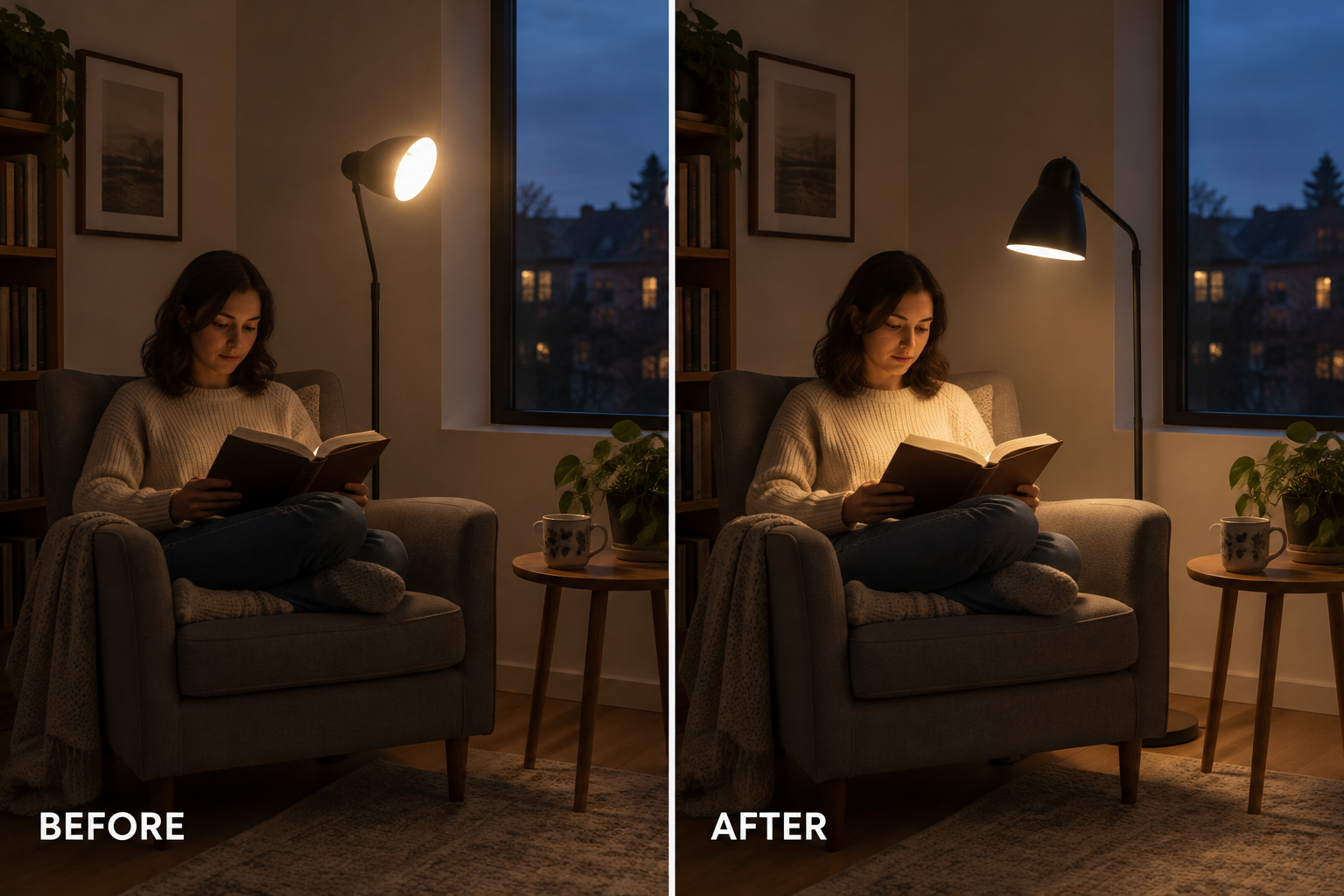
A frequent mistake is compensating for poor aim with a brighter bulb. That can increase glare without putting useful light on the page. A focused head also covers less area than a shaded table lamp, so another person nearby may still need light. This solution may not suit a seat shared by people of very different heights unless the fixture adjusts easily.
3. Choose a Shade That Hides the Bulb
Judge shade shape from the chair, not just from the store aisle. A sufficiently deep shade can hide the bulb at seated eye level, while an open bottom lets light reach a nearby book. For example, replace a shallow shade that exposes the bulb with a deeper drum shade compatible with the lamp’s fitter, bulb clearance requirements, and manufacturer instructions.
Do not assume every fabric shade controls glare: a thin white shade may itself become a bright shape reflected in the screen. Darker or opaque shades reduce sideways light but can make the surrounding corner feel dimmer. A larger shade may also crowd a narrow end table. This swap is less useful when the entire lamp, rather than its exposed bulb, appears in the TV.
4. Filter the Window That Washes Out the Screen
Treat the offending window rather than darkening every window automatically. An adjustable roller shade can reduce daylight during viewing, while a sheer softens milder brightness without fully blocking the view. For example, lower a light-filtering roller shade on the west-facing window during afternoon TV time, leaving another window uncovered to provide comfortable daylight for the rest of the room.
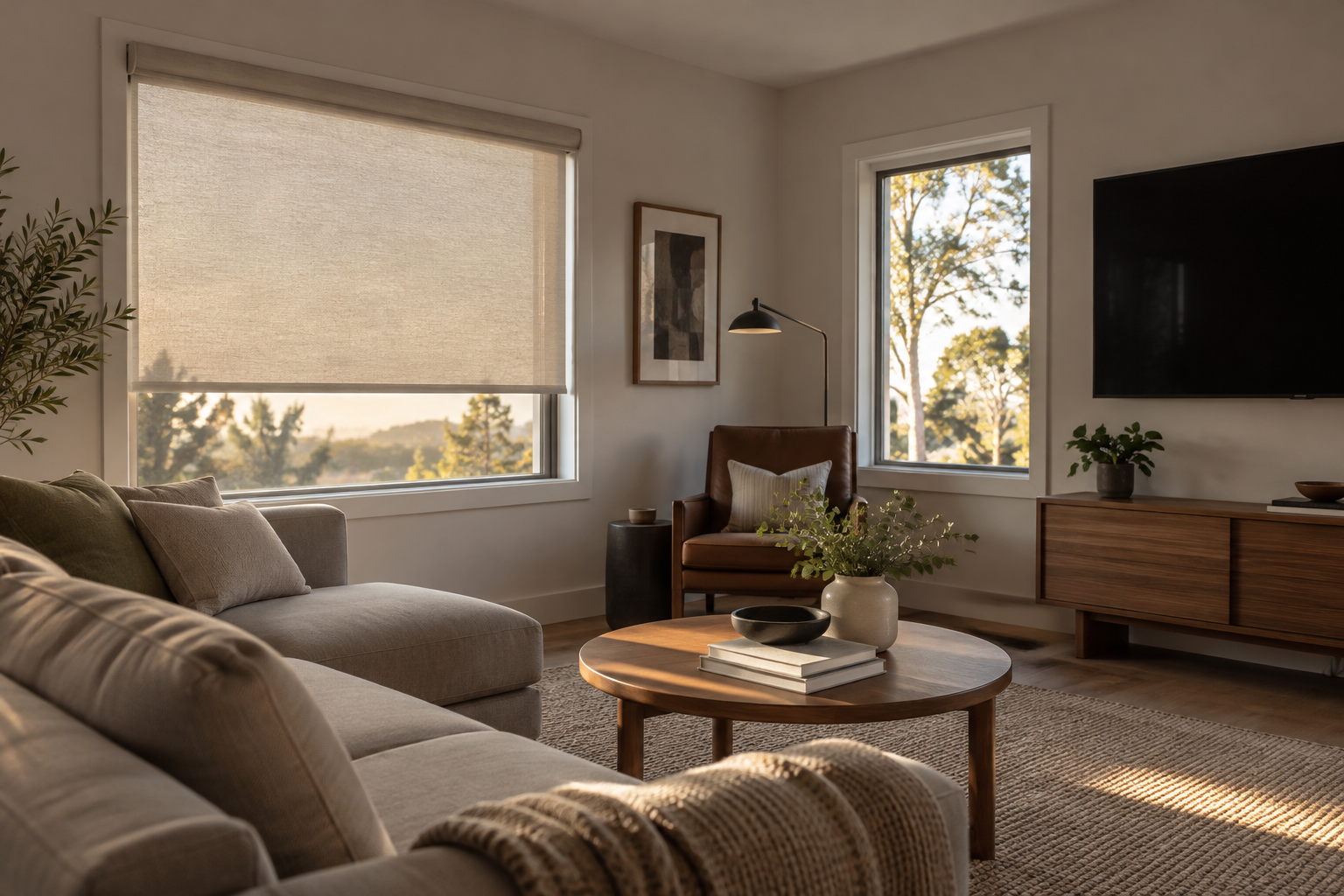
The mistake is expecting a sheer curtain to stop strong direct sun. More opaque coverage controls glare better but reduces daylight and outdoor views; gaps around the edges can still admit bright streaks. Renters should confirm mounting permissions before installing hardware. If the TV directly faces a large sunny window, filtering alone may not be enough, and a furniture or screen-angle adjustment may be necessary.
5. Stop Asking the Ceiling Light to Do Every Job
Use the ceiling fixture for general movement and cleaning, then reduce it for evening viewing while keeping a dedicated reading light on. If replacing a fixture is practical, consider a diffused design that conceals its bulbs. For example, a shaded flush mount can provide background illumination in a low-ceilinged room without the exposed points of light produced by an open multi-bulb fixture.
Simply turning off the overhead light can leave the route to the hallway uncomfortably dark. Conversely, a bright ceiling fixture may reflect in the TV or flatten the whole room. Diffusion softens visible brightness but does not guarantee freedom from reflections. Fixture replacement may not suit a rental or a limited budget; changing how you use existing lamps is often the more practical first step.
6. Match Bulb Color Before Increasing Brightness
Check the Kelvin rating on bulbs that will operate together. Choosing one warm-white target, such as 2700K or 3000K, helps the reading corner and TV area feel connected. For example, replace a cool-white bulb in the floor lamp with one matching the nearby table lamp, then choose brightness separately. Color temperature describes the appearance of the light, not how much light the bulb produces.
A common mistake is choosing bulbs by the word “warm” alone; packaging descriptions vary, so compare the numerical ratings. Matching color will not fix an underpowered reading lamp, and dimming some LEDs changes their appearance. A warmer palette may not suit someone who prefers cooler light for detailed hobbies. If preferences differ, keep the specialty task light localized rather than mixing competing colors throughout the room.
7. Move the Lamp Out of the Screen’s Reflection
If a shaded lamp still appears in the TV, change its location rather than repeatedly changing bulbs. Slide it along the wall in small increments, checking from the main viewing seat after each move. For example, move a slim floor lamp from beside the sofa toward the nearby wall corner until its reflection leaves the screen, provided it still lights the intended seating area.
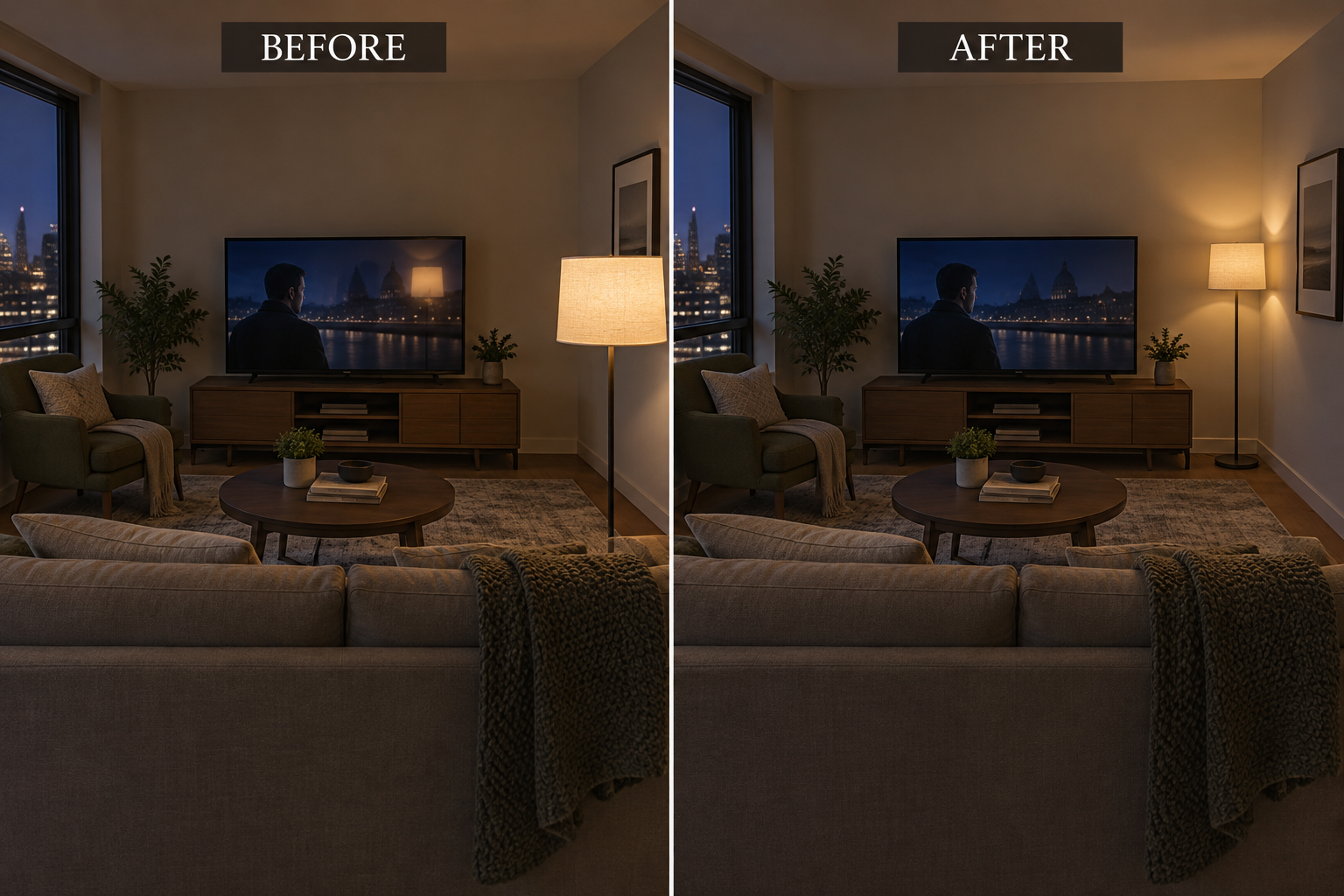
Do not move the lamp into a walkway just because the reflection disappears. Relocation may also put light farther from the reader, making it less useful for close work. In a room with several viewing seats, the new position may solve one angle but create another. This approach may not suit a tight furniture layout unless the lamp has a genuinely clear alternate location.
8. Add Gentle Light Behind the TV
A low-output light behind the television can soften the jump between a bright screen and a dark surrounding wall. Use a concealed light intended for that placement, following its installation and ventilation instructions. For example, position a dimmable strip behind the TV so it creates an even wall glow without visible individual LEDs, then keep it subtle enough that it does not compete with the picture.
The mistake is treating this background glow as a reading light or choosing a bright, shifting color effect that draws attention away from the screen. It will not remove a reflected window or illuminate a book. Dark, heavily textured walls may produce an uneven result, while an open-backed TV location may provide no useful surface for the light to wash. Skip it when there is no suitable backdrop.
9. Control Reading and Viewing Lights Separately
Give lights with different jobs separate controls. A reachable switch or compatible plug-in dimmer lets one person read while another watches TV without flooding the whole room. For example, keep the reading lamp at a useful level and lower the ambient table lamp beside the sofa. Check that the bulb, fixture, and dimming device are compatible and used within their stated ratings.
Avoid putting every lamp on one switched outlet or shared control if they serve different activities. That arrangement is simple but forces reading brightness and viewing brightness to rise together. Incompatible dimmers can cause flicker or unreliable operation. Separate controls may not suit someone who wants one uncomplicated switch; in that case, use two clearly accessible manual switches rather than adding an elaborate control system.
10. Plan the Cord Route Before Placing the Lamp
Trace a safe route to the receptacle before committing to a lamp location. Keep cords along the perimeter, away from doors, chair mechanisms, heat sources, and walking paths. For example, place a reading lamp beside the wall and use suitable removable cord clips along the baseboard, leaving enough slack to avoid tension at the plug. Keep the plug accessible and follow the cord-management product’s instructions.
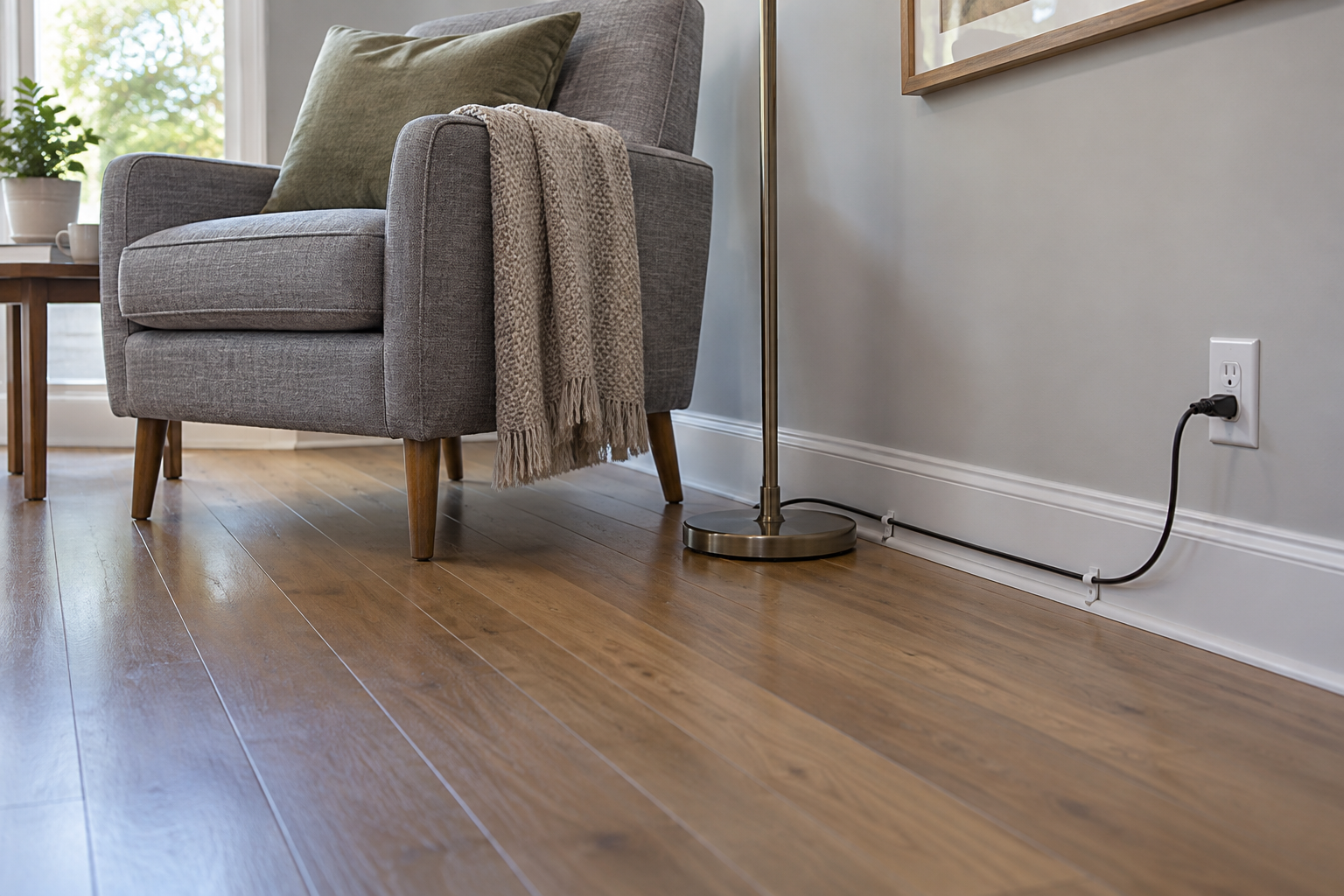
Never hide a cord beneath a rug or pinch it behind furniture to make the arrangement look finished. A floor cord cover can reduce a trip hazard in some situations, but it still creates a raised surface and must suit the application. If the only supply requires crossing the room, reconsider the lamp location. Do not use extension cords as a substitute for permanent wiring.
Start with the reflection check, then fix the reading seat and cord route before adding more light. A small adjustment to aim, shade, or placement may be enough. Keep the page comfortably lit, the screen free of distracting bright shapes, and everyday controls easy to reach.
Leave a Reply