The fitted sheet has popped off the far corner again, and fixing it means leaning across the mattress with one knee tangled in the comforter. When a bed sits against the wall, an ordinary bedding change becomes a series of awkward reaches. You may not need a different bed—or even room to walk around it. The useful changes are smaller: check what can move safely, prepare the sheet before spreading it, and tackle the least accessible parts while the fabric is still loose.

1. Find out whether the frame can safely move
Before pulling the bed away from the wall, identify the frame and check its manufacturer’s instructions. A freestanding frame may permit repositioning; a wall-attached headboard, storage bed, adjustable base, or frame with vulnerable center supports needs different handling. Never move an occupied bed. Keep children and pets out of the working area, and check for cords or attachments before attempting any permitted movement.
Measure the room, furniture, door swings, and proposed access route first. Mark a possible new frame position with removable tape: even a few inches may improve hand access, but it is not necessarily enough room to stand. These are planning checks, not code clearances. If movement would obstruct an exit, ventilation, or a heater’s required clearance, leave the bed where it is and use the stationary methods below.
2. Fit the wall-side corners while the sheet is loose
Start the fitted sheet at the hardest-to-reach corner, usually the wall-side corner near the headboard. Fit the wall-side foot corner next, then finish the two accessible corners. Leaving the near side loose gives you more fabric to guide over the far edge instead of pulling against elastic already stretched tight. Lay the sheet across the mattress first so you are not wrestling its full weight at arm’s length.
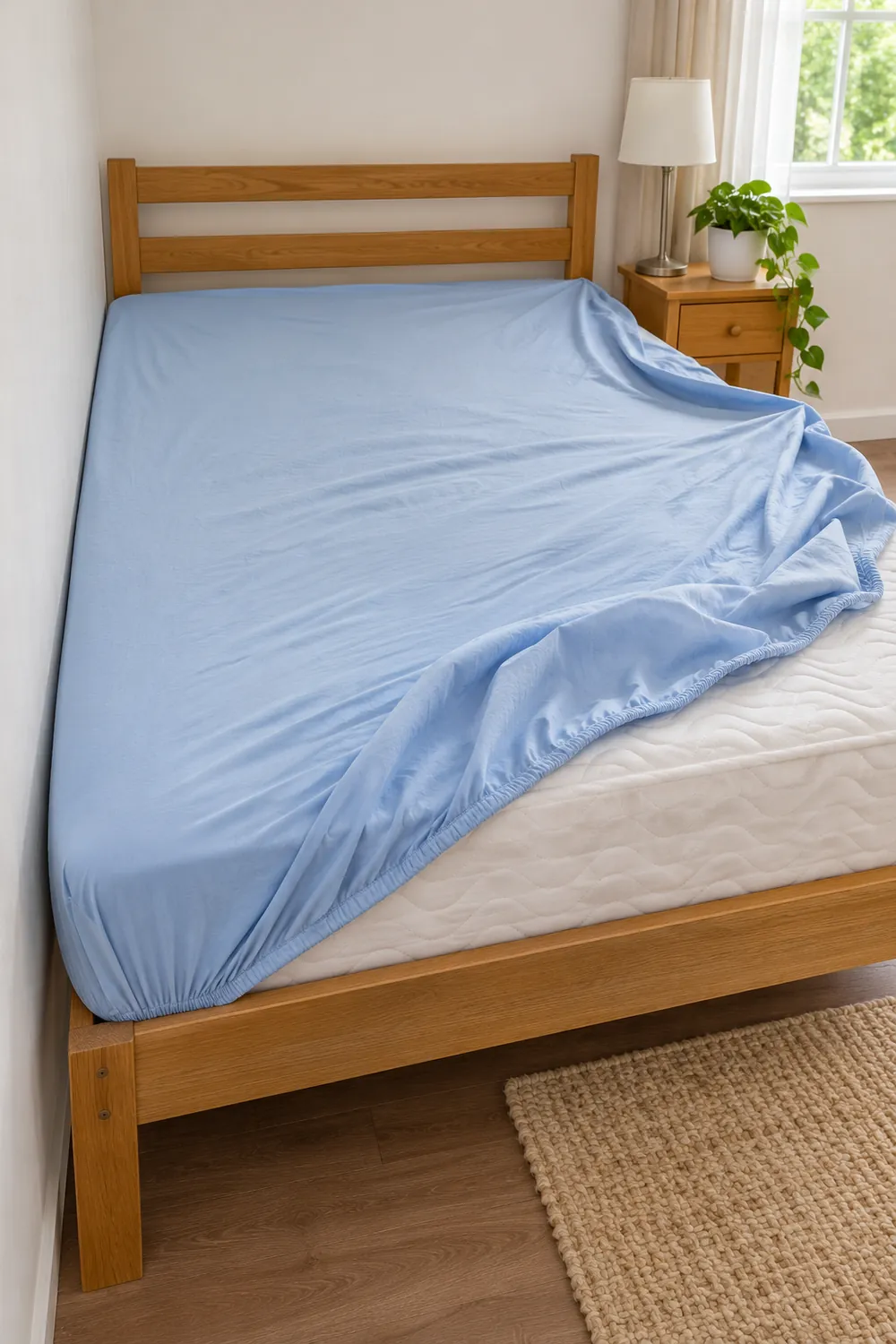
If only one far corner is difficult, do that one first rather than following a fixed clockwise route. Smooth the fabric along the wall before securing the near side. This order reduces resistance; it does not make an unreachable corner reachable. If you cannot reach it without climbing, twisting, or straining, stop and arrange safe access or help rather than forcing the last few inches.
3. Match fitted-sheet pockets to the whole mattress stack
Measure the mattress height with any topper and mattress pad you normally use in place. Compare that total with the sheet maker’s stated fit range, not just a “deep pocket” label. A 12-inch mattress with a 3-inch topper needs a sheet that accommodates the combined height. Check width and length, too: full and queen sheets are not interchangeable.
A shallow pocket can pull the far corner loose as you secure the near one, making your fitting order seem ineffective. Excessively roomy sheets can bunch, so the deepest available pocket is not automatically best. Before replacing anything, confirm that the topper is centered and the sheet is oriented correctly. If it still cannot wrap beneath the corners without excessive force, choose a better-fitting set.
4. Identify the head and foot before spreading the sheet
Check for a “top/bottom” or “side” label while the sheet is still in your hands. Some sheets have these helpful markers; others have only a care tag, whose location is not universal. Establish the correct direction before reaching toward the wall. On a rectangular mattress, turning the sheet a quarter-turn can leave one direction strangely tight and the other full of slack.
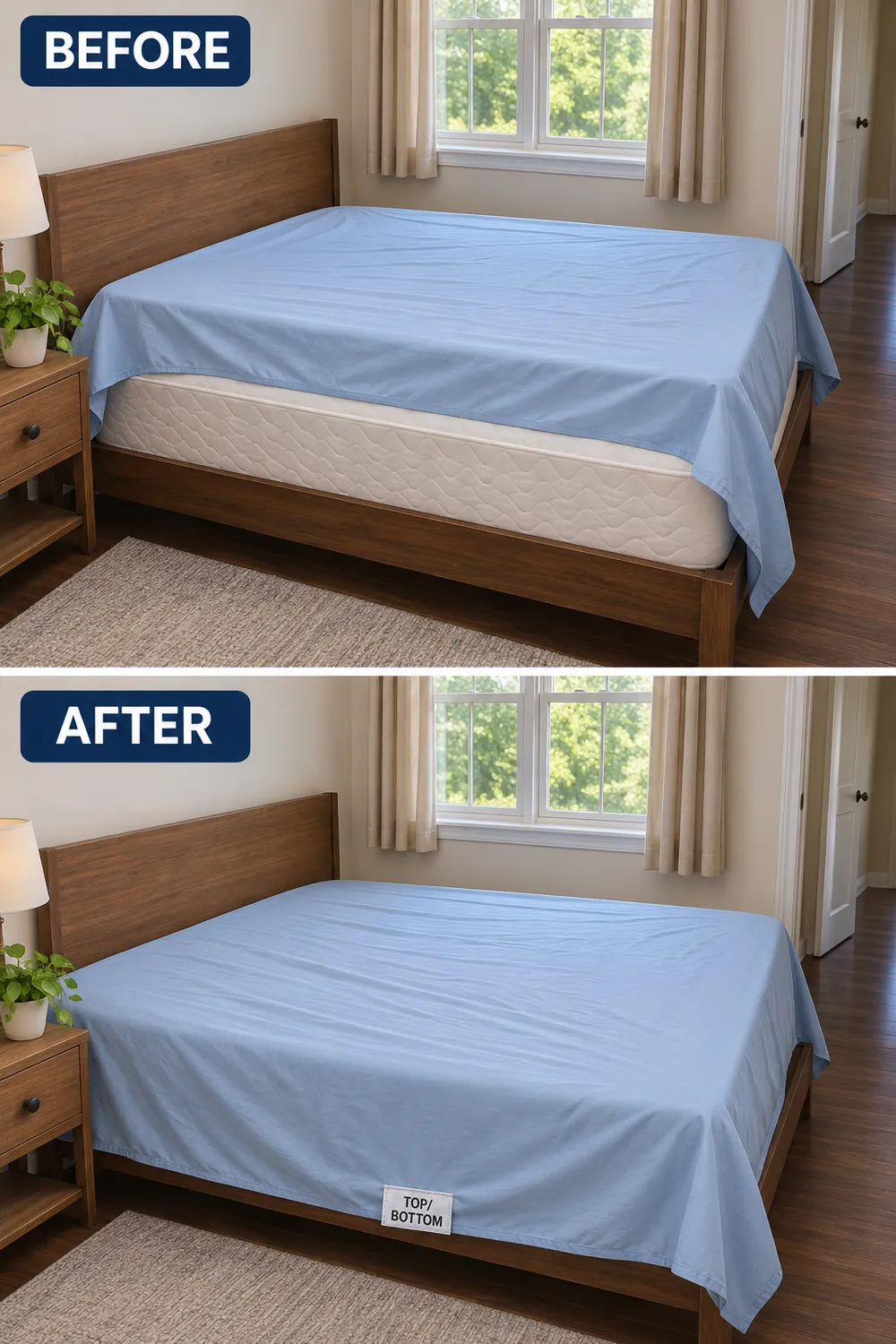
For an unmarked set, identify the correct orientation once and add a small washable fabric-marker dot inside the foot-end hem, following the marker’s instructions. Keep that mark consistent across your sets. Folding the sheet with the marked edge visible also saves searching next time. Do not assume every manufacturer puts its care label in the same corner.
5. Protect the floor before any permitted movement
If the frame can move safely, inspect every floor-contact point before shifting it. Grit beneath a foot can scratch a hard floor; an unnoticed center leg can catch as the frame moves. Use floor protection appropriate to both the flooring and the frame, following their care instructions. Carpet sliders and hard-floor protectors are not automatically interchangeable.
Installing a protector may itself require lifting the frame, so do not attempt it unless that can be done safely with suitable help. Avoid improvised towels that can slip or snag beneath narrow legs. Move only as permitted, without yanking the headboard or dragging unsupported center legs. After returning the bed, check that its supports are upright and stable before anyone gets back in.
6. Use a small, controlled corner lift—not a blind reach
When a reachable corner needs its elastic eased underneath, lift only that mattress corner enough to guide the sheet around it, then lower it slowly. Work from stable footing and keep your hands clear as it settles. The aim is to expose the lower edge briefly, not to hold up a large section of mattress while fishing beneath it.
Try this only if the mattress instructions allow it and the movement is comfortably within your abilities. A thick or floppy mattress may be too difficult to control alone. Do not wedge it up with household objects, reach beneath moving bed mechanisms, or try to lift the entire mattress to reach the wall side. If the corner resists, stop and recruit help.
7. Put the duvet cover on from the open side
Use the accessible edge as your duvet-cover work area. Turn the cover inside out and reach inside to grasp its two closed-end corners. Holding the corresponding insert corners through the fabric, turn the cover over the insert in manageable sections on the mattress. Secure internal ties if provided. Keep the opening near you until the insert is spread and the closure is fastened.
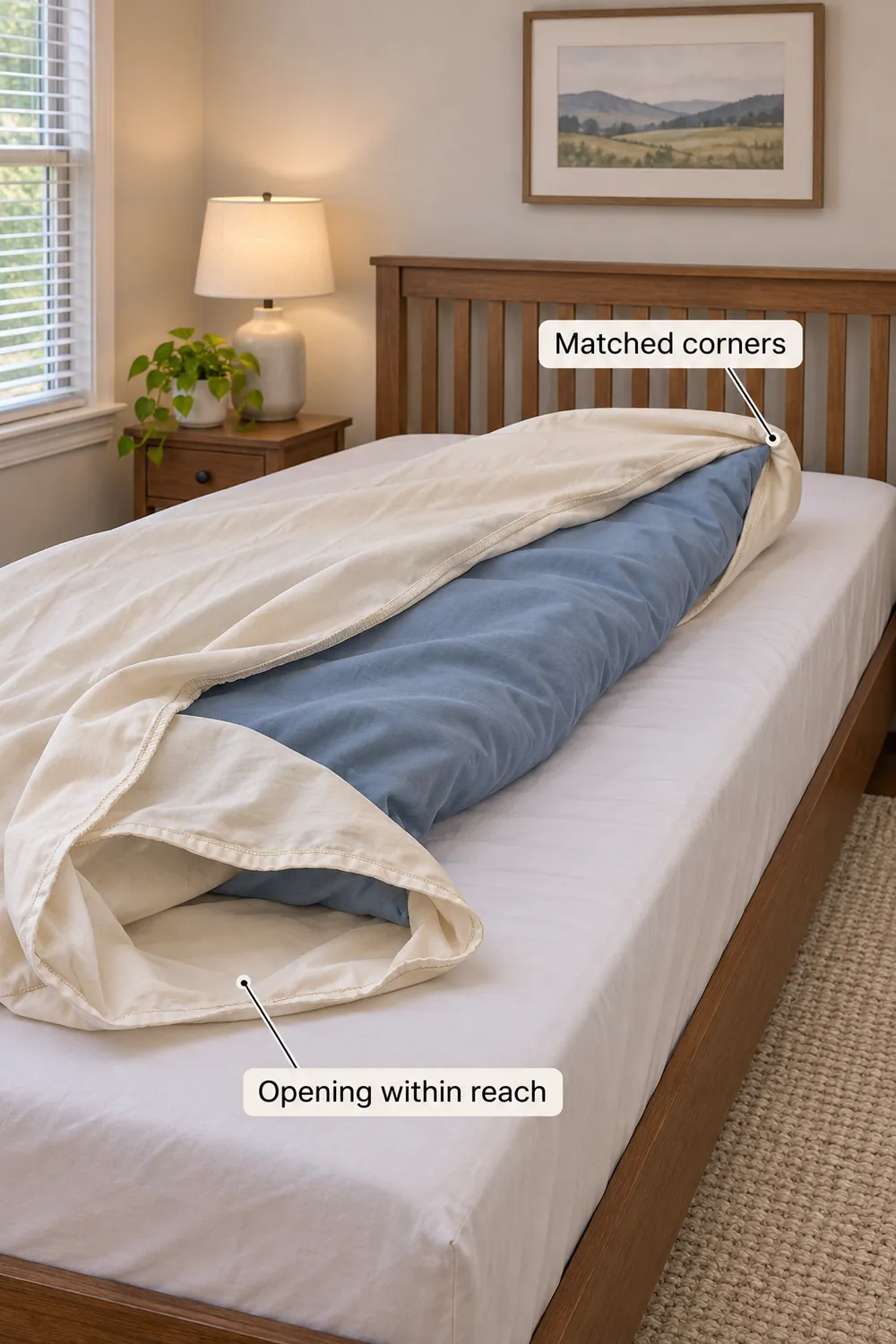
Straighten the filled cover on the bed before pushing its far edge toward the wall. There is no need to shake a large duvet overhead in a narrow aisle. If the insert is bulky, work half the cover over at a time or share the task. This method keeps the floor clear, but it still requires patience when the insert bunches inside the cover.
8. Remove layers that create work without adding comfort
Look at what actually comes off the bed each night. Decorative pillows, a folded throw, and an unused blanket all add handling before you even reach the sheet. Keep the layers that serve your sleeping habits and remove the extras. Two sleeping pillows and one preferred cover may be a more workable everyday setup than a bed that needs dismantling.
The compromise is laundering: skipping a flat sheet generally puts more direct contact on the duvet cover, so plan to wash that cover accordingly. Keeping a flat sheet may suit you better if wrestling a duvet cover is the hardest task. Do not remove a mattress protector simply to save a step; distinguish useful protection from purely decorative layers.
9. Agree on a two-person method for a heavy mattress
For a mattress that is difficult to handle, agree on roles before starting. One person controls a small, permitted corner lift while the other guides the elastic, keeping fingers out from underneath as the mattress lowers. Use simple cues such as “ready,” “lift,” and “lower.” Both people need stable footing and clear access; nobody should squeeze into a gap where they cannot move freely.
An adult helper might manage the accessible foot corner while you position the sheet, then swap tasks if needed. Two people do not make an unsafe maneuver safe, and a helper cannot compensate for having nowhere to stand. If wall-side access remains impossible, use manufacturer-approved repositioning or seek suitable assistance. Do not tip a heavy mattress upright or bend it contrary to its instructions.
10. Stage the change so clean bedding never needs the floor
Bring in the clean set before stripping the bed, but leave it folded on a clean chair outside the working aisle. Put a laundry hamper within reach. Remove decorative layers first, send dirty pillowcases and sheets straight into the hamper, then replace the fitted sheet before unfolding the larger covers. This keeps your one usable side from becoming a pile you must step over.
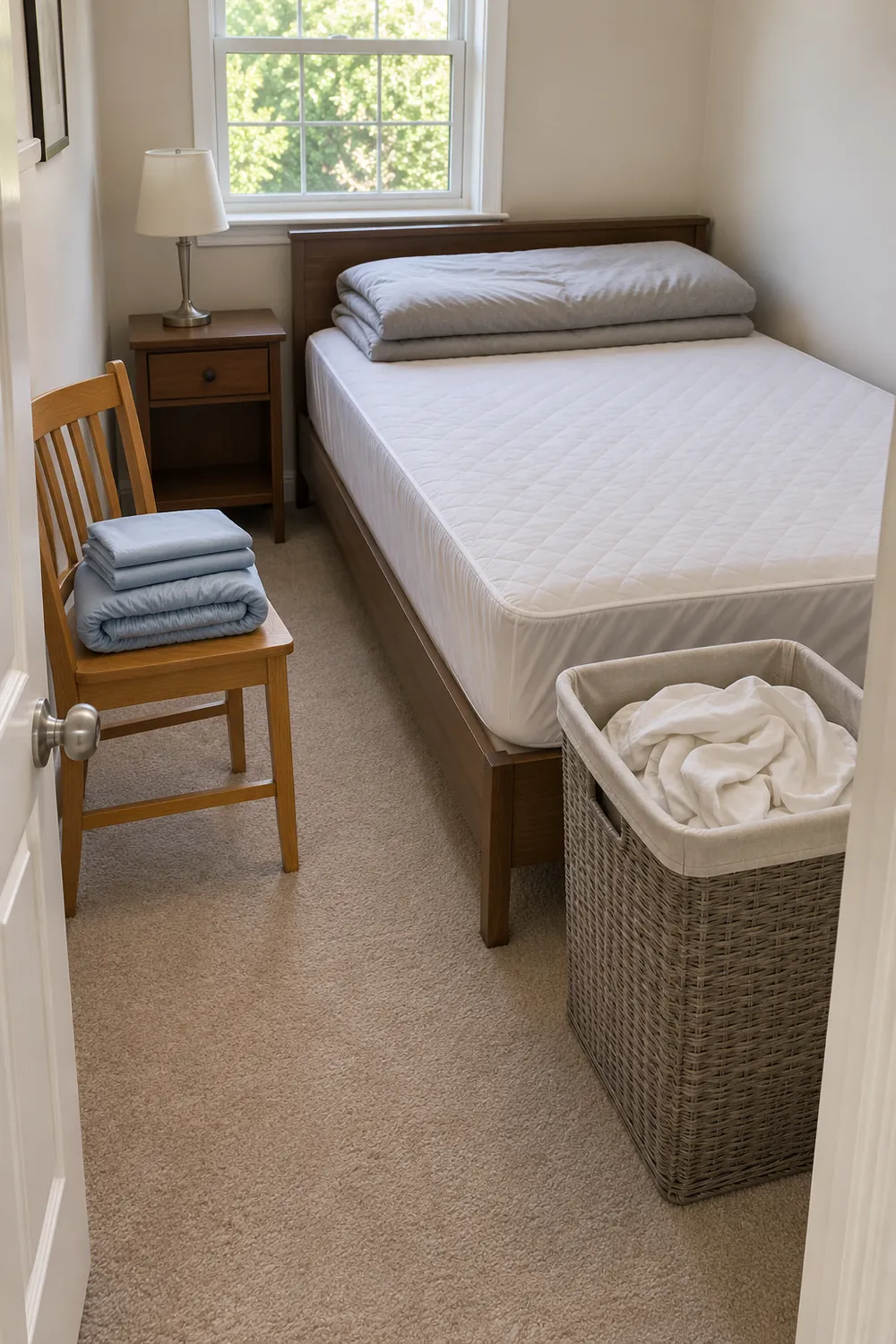
If there is no spare chair, bring clean pieces from another room as needed rather than balancing them on the hamper. A compact retained cover can wait on a clean surface until the fitted sheet is secure. Keeping one complete replacement set together also reduces interruptions; these ways to make stored bedding easier to find can help if locating matching pieces regularly stalls the job.
For the next change, start with two adjustments: identify the sheet’s orientation before spreading it, and fit the hardest corner first. If that corner still requires strain, make safe access or suitable help your next priority—not a stronger tug.
Leave a Reply